
Schaumburg Epoxy Flooring installs basement floor epoxy in Schaumburg, IL, serving surrounding cities including Wood Dale, Bensenville, Barrington, Prospect Heights and Winfield. For more than 20 years we have coated basement slabs on the same rule: the moisture is measured before the price is set, because water decides whether a basement coating lasts or lifts.
A basement slab sits below grade on soil that holds water, and moisture moves up through concrete whether or not the floor ever looks wet. A coating laid over a slab pushing vapor traps it until the film blisters and peels. That is why moisture testing is a line item in our basement scope, not an upsell offered after a floor fails.
Once the reading is known, the rest of the job follows from it: grinding off old paint, repairing cracks, detailing drains and sump pits, choosing a primer, and building a system that suits how the basement is used. When the reading says the floor should not be coated yet, we say that too.
Moisture Comes First in a Basement
How We Test a Basement Slab
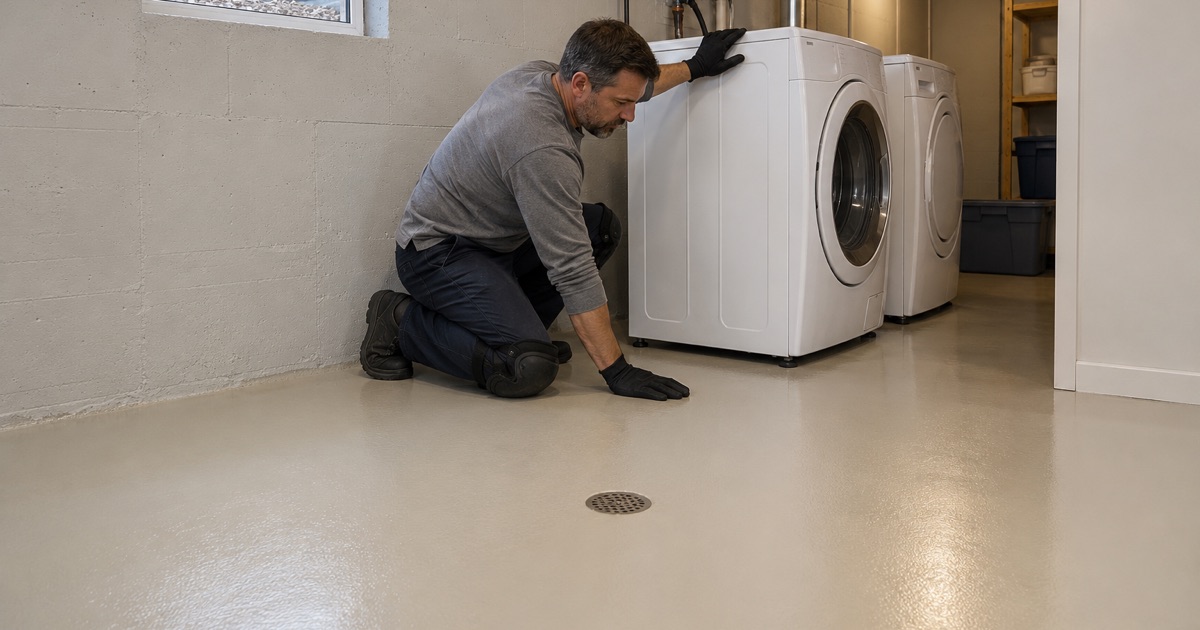
We test with an ASTM F2170 in-situ relative humidity probe set into the slab, an ASTM F1869 calcium chloride kit that measures vapor emission at the surface, or both. A plastic sheet taped down under ASTM D4263 is a useful screen but not a number to coat on. The readings are compared against what the products we plan to use can tolerate.
A single test is a snapshot. Basement floors in the northwest suburbs can read differently in late summer and early spring, so we note the season and the conditions, and on a borderline floor we recommend the mitigation primer rather than gambling on a dry month.
Spring Water Tables and Glacial Till Soils
Much of Schaumburg sits on poorly drained glacial till, clay-rich soils that hold water and carry a seasonal high water table in spring. A basement poured into that ground can see moisture rise for weeks after snowmelt and heavy rain. That is the mechanism behind many basement floors that looked fine at installation and blistered the next April.
The soil also explains why sump pumps run so often here and why footing drains matter. We ask how often your sump cycles in spring and whether water has ever crossed the floor, because those answers tell us more about the slab than its appearance on the day we visit.
Efflorescence and What It Reveals
White, powdery deposits on a basement floor are efflorescence: mineral salts carried up by moving moisture and left behind as it evaporates. They are a sign the slab is passing water. We grind the salts off rather than washing them, test the moisture, and treat the floor as a candidate for a moisture-mitigation primer.
Water, Drains and Plumbing Before the Floor
Hydrostatic Pressure and Its Limits
Hydrostatic pressure is groundwater pushing up against the underside of the slab hard enough to force liquid water through cracks and joints. No coating is designed to hold that back. If water is entering under pressure, the fix is drainage, a sump system or exterior grading, and we will tell you so rather than sell a floor that becomes a membrane holding a puddle.
Floor Drains, Sump Pits and the Cove Joint
We coat up to and around each floor drain without blocking it, keep the drain’s pitch working, and detail the sump pit edge so the lid stays removable. The cove joint, where the floor meets the foundation wall, is where seepage often appears first, so we look at it closely and seal it only after we understand what it is doing.
Where a basement has a laundry or a mechanical room, we plan for the water those spaces see: a washer hose that fails, a water heater that leaks, a condensate line that drips. A coated floor that slopes to a working drain turns those events into a mop job rather than a damaged floor.
Sewer Backups and Overhead Sewers
Many older homes in the area drain to gravity sewers that can back up into the basement when the main surcharges during a heavy storm. Schaumburg’s Overhead Sewer Cost Share Program reimburses half the cost of an overhead sewer installation, up to $5,000, and a similar program covers footing-drain disconnection with a sump pump. We point homeowners to both before coating a floor that has flooded.
After a backup, the floor has to be cleaned, disinfected and fully dried, and the cause corrected, before any coating goes down. We test the slab once it has dried, because concrete that was underwater can hold moisture for weeks after the surface looks dry.
Building the Basement Floor System
Moisture-Mitigation Primers
When the slab reads above what the coating can tolerate, a moisture-mitigation primer goes down first. It is a dense epoxy built to reduce vapor transmission, and the rest of the system bonds to it. It adds material and a day to the job, and we recommend it only when the readings or the history of the floor call for it.
The primer is not a cure for a basement that floods. It is designed for vapor moving through sound concrete, not for liquid water standing on the floor or forced through a crack. On a slab with both a high reading and a history of seepage, we treat the seepage as the first job, then retest before the primer is chosen.
Cracks, Patches and Old Floor Covering Residue
Basement floors collect history: cracks from settlement, patches where a bathroom was roughed in, black mastic from old tile and glue lines from carpet. Each of them has to come off or be repaired before coating. We grind adhesive residue down to clean concrete and tell you plainly which cracks are stable and which may show through the finished floor.
Finishes for Playrooms, Gyms and Workshops
A lived-in basement wants a floor that is easy on the eyes and easy to clean. A light vinyl flake broadcast under a satin topcoat hides dust and scuffs, while a metallic epoxy finish suits a bar or media room. Workshops and laundry areas do well with a solid color and a little texture for grip near the washer.
Coatings and Radon
A coating seals the surface it covers but is not a radon mitigation system, and in Illinois that work requires an IEMA radon mitigation license. If a radon test has come back high, we recommend having a licensed mitigator install the system first. We then coat around the suction pipe and any cracks they sealed, so the floor and the mitigation work together.
Our Step-by-Step Basement Floor Epoxy Process
Step 1: History, Inspection and Testing
We ask about past water, backups and sump activity, inspect the slab, cracks, drains and wall joint, and set our moisture tests. Every home job then gets a written proposal, a written contract and the state’s consumer-rights pamphlet before work begins.
Step 2: Grinding and Repair
Old paint and sealers are ground off with dust collection, cracks are filled and ground flush, and efflorescence is removed mechanically. We protect stairs, finished walls and mechanical equipment before the grinder starts.
Step 3: Primer and Base Coat
A moisture-mitigation primer goes down where the readings call for one, followed by the base coat and any flake or metallic layer. Drains, the sump edge and the base of each wall are detailed by hand.
Step 4: Topcoat and Handoff
The topcoat seals the system. We give you cure times for foot traffic and furniture, explain how to care for the floor, and read the warranty exclusions with you, with moisture first on the list.
- 20+ Years Coating Floors
- Moisture Tested Before Coating
- Written Contract on Every Home Job